Site Map Icon
RSS Feed icon


May 18, 2012
Member Login
Username:

Password:

Forgot Your Login?
Site Search
Site Map
RSS Feeds

  
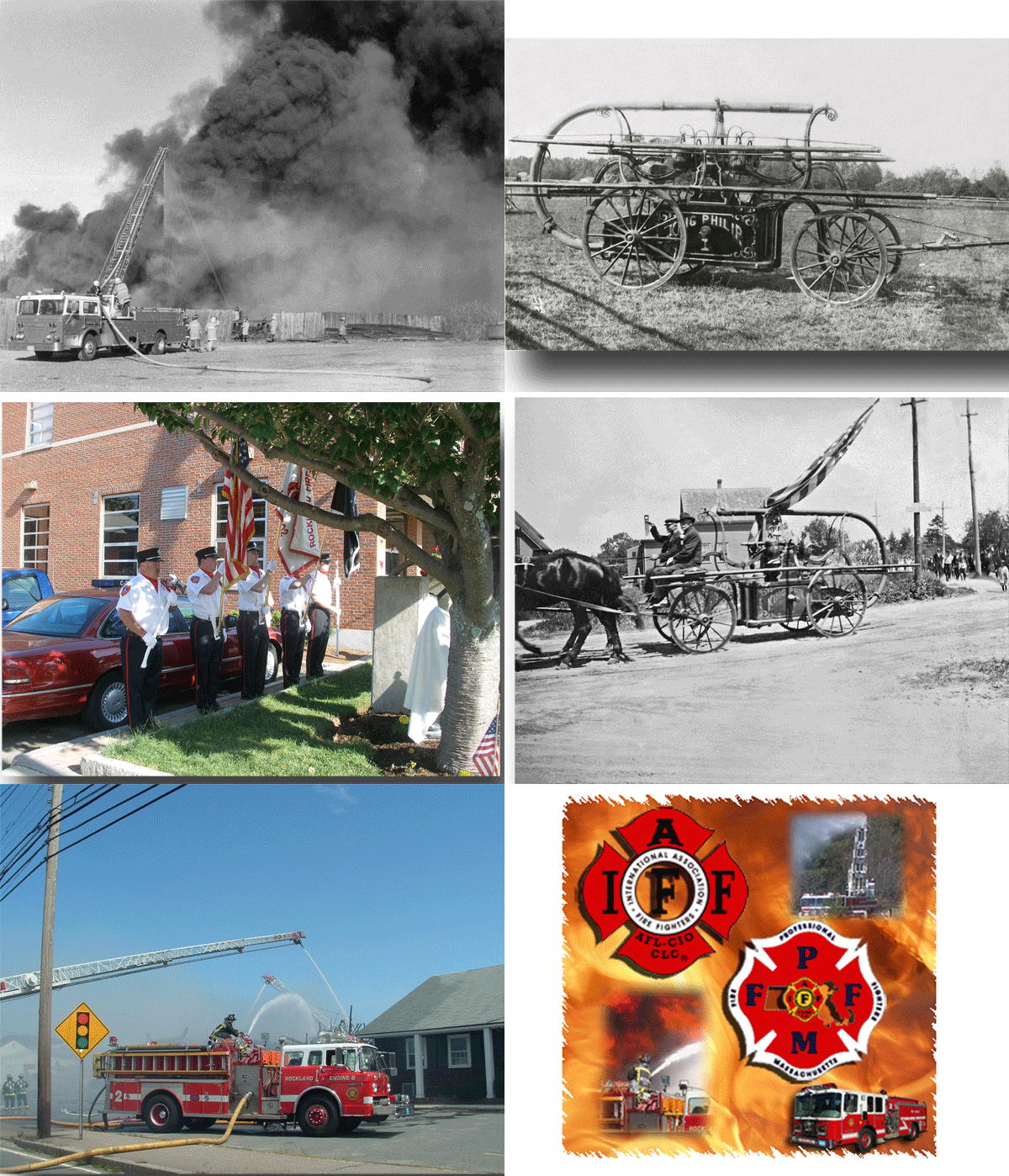
Public Request for Historical Pictures or Images of the Rockland Fire Department
The Rockland Firefighters are working on recording and preserving the history of the Rockland Fire Department and we need the public’s help.
Read More...


What's New at Local 1602
Firefighting - Deadliest Job in MA in 2011
Apr 27, 2012

The Deadliest Jobs in Massachusetts

Thursday, April 26, 2012


Fifty eight workers died on the job in Massachusetts last year and firefighting supplanted construction as the most dangerous job in the state, according to a report from the Massachusetts Coalition for Occupational Safety and Health (MassCOSH).


Firefighting overtook construction as the deadliest job in the state in 2011, rising from 5 work-related deaths in 2010 to 13 last year, accounting for 22 percent of all workplace fatalities. In 2010, the construction industry topped the list with 10 on-the-job deaths, but dropped to second place with 8 fatalities. Also on the list for 2011 were the transportation industry with 7 job-related deaths, and three commercial fishermen died to their trade, compared with four in 2010. The human services industry, with workers in the mental health, social services and other areas, lost three employees in 2011. Three people also died doing tree care and removal.

New report

The news is part of a report entitled “Dying to Work in Massachusetts: Loss of Life and Limb in Massachusetts Workplaces. MassCOSH released the report Wednesday, three days before the 23rd Workers’ Memorial Day Saturday, April 28. Of all the information included in the report, one piece stands out the most for Jeff Newton, membership and communications coordinator for MassCOSH.

“What we find most disturbing,” Newton said, “Is that it’s often the same types of accidents leading to death on the job, year after year.”

Motor vehicle-related accidents and falls led the way in 2011, just as they did in 2010. Each accounted for 12 of the 58 work-related deaths last year, combining to make up almost a quarter of all fatalities. The number of transportation-related deaths was the same as in 2010, while deaths resulting from falls rose from nine that year.

The other alarming fact: the 58 workplace deaths last year represented an increase of 11 over the 47 in 2010. It broke a string of four straight years of decline in on-the-job fatalities: from 80 in 2007, to 66 in 2008, 60 in 2009 and 47 in 2010.


Who is dying

Most people recognize the dangers firefighters face each and every day, not unlike their counterparts in law enforcement. And when a firefighter dies, the tributes and memorials are sincere and moving. Still, 13 firefighters lost their lives on the job last year and all but three of them died as the result of cancer or heart disease.

Two, including Worcester’s Jon Davies, died while battling a fire, while another was crushed while working on an emergency vehicle. Davies was 43 when he died Dec. 8 after a triple-decker collapsed during a three-alarm fire.

While active, line-of-duty deaths may capture the public’s attention, occupational cancer is a huge threat to firefighters, especially because of the chemicals and other substances released into the air during a fire.

“Not long ago, we were seeing many cases of black lung and white lung,” Newton said. “There are still certain professions where there are exposures that can lead to these and other complications. It’s not just work-place fatalities, but illnesses. Cancer is a disease commonly associated with firefighting.”

In fact, while most people are well aware of the immediate physical hazards for particular jobs, they may not consider the illnesses that can be contracted. In 2011, an estimated 580 workers died from occupational disease. About 1,800 new cases of cancer were diagnosed in Massachusetts last year, also. Additionally, 50,000 other workers were seriously injured.

The average age of an employee who died on the job in 2011 was 49, but the majority of those who died on the job – 54 percent – were 50 and older.


How they are dying

On the job motor vehicle accidents and falls are repeat offenders when it comes to leading causes of worker deaths. It is something that deeply troubles Newton.

“We strongly encourage workplaces to make their workers’ health and safety a main priority of their business,” he said.

Sadly, that is often not the case, especially when it comes to falls in the construction industry. There were 12 total deaths as a result of falling in 2011 – five on construction sites. From 2007-2011, 76 Massachusetts workers died in a fall while working construction. Construction-related falls accounted for 44 of them, or 58 percent. The majority of workers – 25 percent – fell from roofs.

“We find many employers are not providing construction workers with fall protection,” said Newton. “There are many needless deaths each year.”

The Massachusetts Department of Public Health (DPH) acknowledged the issue of the same types of accidents occurring on the job every year, and said it and other agencies work hard for change.

“We do see similar patters over time,” said Letitia Davis, director of the DPH Occupational Health Surveillance Program. “In terms of absolute numbers of deaths and their rates, that continues to stand out.”

Falls, added Davis, are a “significant problem.” She said there is a national movement to reduce the number of falls in the construction industry.

Temp work dangers

One of the problems, as Newton sees it, is the hiring done by temporary agencies. Often times, he said, those applying for low-skilled labor jobs are immigrants and others who speak little to no English and may have no idea what they’re getting into. Some of these workers show up at a site believing they’re working for the company that’s there, when in fact they’re employed by an agency.

“There is a pool of labor with limited English skills seeking employment in low-skilled jobs,” Newton said. “They are targeted by temp agencies that seek profit over all else. They realize they can bully them around.”

Organizations like MassCOSH stand firmly behind laws such as the “Temporary Worker Right to Know Law,” House Bill 1393. Among other things, it would require employers to provide workers with limited English skills any necessary documents in their native language.

Other causes

Motor vehicle incidents are another concern. They also accounted for 12 job fatalities, half involving a car or truck crash and the other six involving a worker struck or crushed by a vehicle. Workplace violence accounted for six deaths in 2011, including 25-year-old Stephanie Moulton, an assistant manager at the North Suffolk Mental Health residential home. She was abducted and killed by a client while working on Jan. 20 last year.

Five drowning deaths occurred last year, three of them in the commercial fishing industry.

Firefighters’ deadly burden

Having ascended to the top of list of deadliest jobs, firefighters find themselves in the spotlight once more. Most people know the job is dangerous, but many may not consider the dangers posed not just while battling a fire, but long after the last embers have burned. With 10 firefighters succumbing to cancer or heart disease last year, greater attention should be turned on many other they face, according to Davis.

“Firefighters face a broad range of hazards, from death to exposure to harmful chemicals and other elements,” Davis said. “There’s also the stress that goes along with that job. It’s a high-risk industry.”

No one has to tell that to Edward Kelly, president of the Professional Firefighters of Massachusetts. He has seen the numbers – but more importantly, he and thousands of other firefighters have lived them.

“The data clearly shows as firefighters we’re exposed to carcinogens,” Kelly said. “We have an extremely high likelihood of being diagnosed with cancer, lung disease and cardiac events. That is due to the exposure to so many different things, the high stress over many, many years and the extreme rush of adrenaline to the heart.”

Knowing they could die at any time comes with the job, but doesn’t make it any easier, according to Dennis Leger, executive aide to the Springfield Fire Commissioner.

“Nobody’s looking to come to work and not come home,” he said. “But things happen very quickly in this business. Firefighting is an inherently dangerous profession. The numbers are an indicator that it's the nature of the best. But a well-trained and well-equipped firefighter is a safe firefighter.”

That has been one of the problems of late, Kelly said. Money has been tight and cuts have been made. That has unfortunately led to an increase in injuries and accidents.

“In these challenging economic times, often fire departments become the chopping block for local budgets,” Kelly said. “Things like replacing fire apparatus, investing in training and maintaining and providing the newest equipment suffer. Firefighters are often forced to do more with less.”

Dangers in other areas


Moulton probably wasn’t expecting that Jan. 20, 2011 would be her last day alive, but it was. She was one six people killed while working last year. Budget cuts and other factors can all be pointed to as factors, but there are steps being taken to protect employees from workplace violence, especially human service workers. One involves a push to pass “An Act to Promote Public Health through Workplace Safety for Social Workers,” House Bill 592 and Senate Bill 1206.


Stephanie’s Law, which has been pushed by Moulton’s mother and sponsored by Senator Fred Berry, D-Peabody, would require social service workers, who often work in isolated circumstances, to carry an emergency device similar to that often made available to senior citizens. The worker would be able to click a button and send an immediate emergency signal to authorities. MassCOSH sees that as a necessity.

“Some social workers work with clients by themselves,” Newton said. “They should not be working alone at any time of day or night. It can expose them to a client who is not in a state mind ideal for the safety and health of the worker.”

A stronger OSHA

Davis said much as has been done to try to increase workplace safety, citing Gov. Deval Patrick’s Executive Order 511, which he signed in 2009. The order established the Massachusetts Employee Safety and Health Advisory Committee and signaled the state’s commitment to providing a healthy and safe working environment.

But one of the most important steps that can be taken, according to Newton, is to properly staff and fund local Occupational Safety and Hazard Administration OSHAchapters. He also lamented the fact that Massachusetts is one of only a handful of states that does not have OSHA protection for state employees.

“OSHA has been responsible for a fantastic reduction in workplace fatalities and injuries,” he said. “It is a fantastic tool. It is understaffed and underfunded. Another problem is many times the fines they assess are just a couple thousand dollars. A lot of employers find it cheaper just to pay the fine and not pay for new equipment.”

The state Legislature would have to vote to adopt OSHA protection for state workers.


Woman injured, cat rescued in Rockland house fire
Apr 03, 2012
Woman injured, cat rescued in Rockland house fire
 
SS422012rocklnd1.jpg
Stephanie Spyropoulos/For The Patriot Ledger
A firefighter administers oxygen to a cat rescued in a house fire in Rockland on Monday, April 2, 2012
 
By Stephanie Spyropoulos
Posted Apr 02, 2012 @ 04:12 PM
Last update Apr 03, 2012 @ 01:09 AM
 

Fire destroys camper behind vacant building in Rockland
Mar 16, 2012

Firefighters battled a fierce blaze and exploding propane tanks inside a pop-up camper set up behind a vacant building. No one was injured.

Several people called police at about 9:30 p.m. Tuesday to report the sound of an explosion coming from the property at 324 Howard St.

Rockland Fire Chief Scott Duffey said the 12- by 6-foot camper was engulfed in flames when firefighters arrived. It took them about 20 minutes to extinguish the fire. Complicating their efforts, Duffey said, were exploding propane tanks inside the camper and several sitting near it.

“We had actively leaking propane tanks. We kept the hose lines on them to disperse the propane into the atmosphere and keep the heat down,” he said.

The state Fire Marshal’s office is investigating the cause of the fire. “The usual causes of fire were not present and foul play is being investigated related to this fire,” Duffey said.


Rockland and Abington Receive AFG Grant
Mar 01, 2012

U.S. Sens. John Kerry and Scott Brown, and U.S. Reps. Stephen Lynch, D-South Boston, and Niki Tsongas, D-Lowell, recently announced that fire departments and emergency response teams across Massachusetts will receive an additional $2.7 million in federal funding for training and safety gear.

Several South Shore towns are among the 13 communities in Massachusetts that have been granted additional funds. The Halifax Fire Department received $799,920, the Rockland Fire Department received $630,090, the Kingston Fire Department received $54,168, and the Hanover Fire Department received $15,200.

“With local budgets crunched, this investment helps make up some of the difference and makes sure that our firefighters are as safe as possible doing an unbelievably dangerous job. Equipment and training is the least we can provide for these heroes,” said Kerry.

The funding was awarded by the Federal Emergency Management Agency’s Assistance to Firefighters Grants program. The money is intended to go toward training, health programs, new safety equipment and emergency vehicles for front-line firefighters.

Brown said: “Our fire chiefs and firefighters always tell me how important these grants are, and I’m proud that our local departments continue to receive this much-needed support. Our firefighters deserve to have the equipment and training necessary to continue doing the heroic work of protecting our communities.”


Kitchen Fire on Reed St.
Feb 28, 2012


Rockland firefighters quickly knocked down a kitchen fire at 260 Reed St. on Monday.

Chief Scott Duffey said a fire in a microwave oven at about 5 p.m., caused heat damage to the kitchen and smoke damage throughout the house. Duffey said there were no injuries among firefighters or the three occupants of the house.

He said the residents will not be able to return to the home immediately.

Abington firefighters covered the Rockland station during the fire, Duffey said.


Click the play button for a live scanner feed of Rockland Fire
  IAFF LOCAL NEWSWIRE  
 
Join the Newswire!
Updated: May. 18 (05:10)

Meet & Greet
Professional Firefighters of Maine
Meet and Greet to Elect One of Us
Professional Firefighters of Maine
Website Update
Scranton Firefighters IAFF Local # 60
Memorial Day Parade
Pittsburgh Fire Fighters IAFF Local No.1
N.Y. pension chiefs sing praises of DB plans
UPFFA
Special Membership Meetings Scheduled
IAFF Local 4416
 
     
Action Center
FLU.gov
Know what to do about the flu.
Click for Photo Gallery

Important Links
Visit www.iaff.org!
Visit www.pffm.org!
Visit www.iafflocals.com!
Visit www.iafflocals.net/!
Visit www.firefighterclosecalls.com/!
Visit www.thebravestonline.com!
Visit www.vententersearch.com/!
Visit www.everyonegoeshome.com/index.html!
MassFireTrucks.com
Visit www.breakingnewsnetwork.com/!
Rockland Police
Visit brotherhoodinstructors.com/index.html!
Visit www.animatedknots.com/indexrescue.php?LogoImage=LogoGrog.jpg&Website=www.animatedknots.com!
 
 
Rockland Fire Fighters
Copyright © 2012, All Rights Reserved.
Powered By UnionActive™

443072 hits since Jan 16, 2007
Visit Unions-America.com!

Top of Page image